
Fukushima: A Nuclear War without a War
The Unspoken Crisis of Worldwide Nuclear Radiation
Michel Chossudovsky (Editor)
I-Book No. 3, January 25 2012
Global Research's Online Interactive I-Book Reader brings
together, in the form of chapters, a collection of Global Research
feature articles and videos, including debate and analysis, on a broad
theme or subject matter.
In this Interactive Online I-Book we bring to the
attention of our readers an important collection of articles, reports
and video material on the Fukushima nuclear catastrophe and its impacts
(scroll down for the Table of Contents).
INTRODUCTION
The World is at a critical crossroads. The Fukushima
disaster in Japan has brought to the forefront the dangers of Worldwide
nuclear radiation.
The crisis in Japan has been described as "a nuclear war without a war". In the words of renowned novelist Haruki Murakami:
"This time no one dropped a bomb on us ... We set the stage, we committed the crime with our own hands, we are destroying our own lands, and we are destroying our own lives."
Nuclear radiation --which threatens life on planet
earth-- is not front page news in comparison to the most insignificant
issues of public concern, including the local level crime scene or the
tabloid gossip reports on Hollywood celebrities.
While the long-term repercussions of the Fukushima
Daiichi nuclear disaster are yet to be fully assessed, they are far more
serious than those pertaining to the 1986 Chernobyl disaster in the
Ukraine, which resulted in almost one million deaths (New Book Concludes - Chernobyl death toll: 985,000, mostly from cancer Global Research, September 10, 2010, See also Matthew Penney and Mark Selden The Severity of the Fukushima Daiichi Nuclear Disaster: Comparing Chernobyl and Fukushima, Global Research, May 25, 2011)
Moreover, while all eyes were riveted on the
Fukushima Daiichi plant, news coverage both in Japan and internationally
failed to fully acknowledge the impacts of a second catastrophe at
TEPCO's (Tokyo Electric Power Co Inc) Fukushima Daini nuclear power
plant.
The shaky political consensus both in Japan, the U.S. and Western Europe is that the crisis at Fukushima has been contained.
The realties, however, are otherwise. Fukushima 3 was
leaking unconfirmed amounts of plutonium. According to Dr. Helen
Caldicott, "one millionth of a gram of plutonium, if inhaled can cause cancer".
An opinion poll in May 2011 confirmed that more than
80 per cent of the Japanese population do not believe the government's
information regarding the nuclear crisis. (quoted in Sherwood Ross, Fukushima: Japan's Second Nuclear Disaster, Global Research, November 10, 2011)
The Impacts in Japan
The Impacts in Japan
The Japanese government has been obliged to
acknowledge that "the severity rating of its nuclear crisis ... matches
that of the 1986 Chernobyl disaster". In a bitter irony, however, this
tacit admission by the Japanese authorities has proven to been part of
the cover-up of a significantly larger catastrophe, resulting in a
process of global nuclear radiation and contamination:
"While Chernobyl was an enormous unprecedented disaster, it only occurred at one reactor and rapidly melted down. Once cooled, it was able to be covered with a concrete sarcophagus that was constructed with 100,000 workers. There are a staggering 4400 tons of nuclear fuel rods at Fukushima, which greatly dwarfs the total size of radiation sources at Chernobyl." ( Extremely High Radiation Levels in Japan: University Researchers Challenge Official Data, Global Research, April 11, 2011)
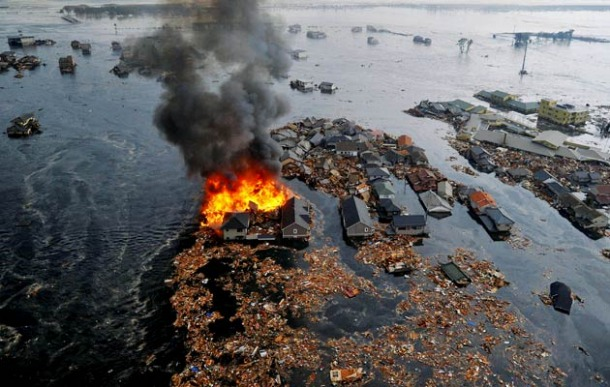
Fukushima in the wake of the Tsunami, March 2011
Worldwide Contamination
The dumping of highly radioactive water into the
Pacific Ocean constitutes a potential trigger to a process of global
radioactive contamination. Radioactive elements have not only been
detected in the food chain in Japan, radioactive rain water has been
recorded in California:
"Hazardous radioactive elements being released in the sea and air around Fukushima accumulate at each step of various food chains (for example, into algae, crustaceans, small fish, bigger fish, then humans; or soil, grass, cow's meat and milk, then humans). Entering the body, these elements - called internal emitters - migrate to specific organs such as the thyroid, liver, bone, and brain, continuously irradiating small volumes of cells with high doses of alpha, beta and/or gamma radiation, and over many years often induce cancer". (Helen Caldicott, Fukushima: Nuclear Apologists Play Shoot the Messenger on Radiation, The Age, April 26, 2011)
While the spread of radiation to the West Coast of
North America was casually acknowledged, the early press reports (AP and
Reuters) "quoting diplomatic sources" stated that only "tiny amounts of
radioactive particles have arrived in California but do not pose a
threat to human health."
"According to the news agencies, the unnamed sources have access to data from a network of measuring stations run by the United Nations’ Comprehensive Test Ban Treaty Organization. ...... Greg Jaczko, chair of the U.S. Nuclear Regulatory Commission, told White House reporters on Thursday (March 17) that his experts “don’t see any concern from radiation levels that could be harmful here in the United States or any of the U.S. territories”.
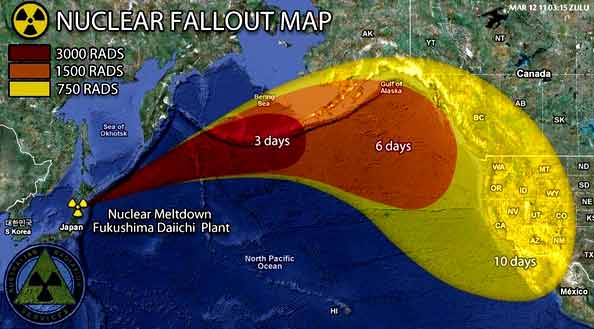

The spread of radiation. March 2011
Public Health Disaster. Economic Impacts
What prevails is a well organized camouflage. The
public health disaster in Japan, the contamination of water,
agricultural land and the food chain, not to mention the broader
economic and social implications, have neither been fully acknowledged
nor addressed in a comprehensive and meaningful fashion by the Japanese
authorities.
Japan as a nation state has been destroyed. Its
landmass and territorial waters are contaminated. Part of the country is
uninhabitable. High levels of radiation have been recorded in the Tokyo
metropolitan area, which has a population of 39 million (2010) (more
than the population of Canada, circa 34 million (2010)) There are
indications that the food chain is contaminated throughout Japan:
Radioactive cesium exceeding the legal limit was detected in tea made in a factory in Shizuoka City, more than 300 kilometers away from the Fukushima Daiichi nuclear power plant. Shizuoka Prefecture is one of the most famous tea producing areas in Japan.A tea distributor in Tokyo reported to the prefecture that it detected high levels of radioactivity in the tea shipped from the city. The prefecture ordered the factory to refrain from shipping out the product. After the accident at the Fukushima nuclear power plant, radioactive contamination of tea leaves and processed tea has been found over a wide area around Tokyo. (See 5 More Companies Detect Radiation In Their Tea Above Legal Limits Over 300 KM From Fukushima, June 15, 2011)
Japan's industrial and manufacturing base is
prostrate. Japan is no longer a leading industrial power. The country's
exports have plummeted. The Tokyo government has announced its first
trade deficit since 1980.
While the business media has narrowly centered on the
impacts of power outages and energy shortages on the pace of productive
activity, the broader issue pertaining to the outright radioactive
contamination of the country's infrastructure and industrial base is a
"scientific taboo" (i.e the radiation of industrial plants, machinery
and equipment, buildings, roads, etc). A report released in January 2012
points to the nuclear contamination of building materials used in the
construction industry, in cluding roads and residential buildings
throughout Japan.(See FUKUSHIMA:
Radioactive Houses and Roads in Japan. Radioactive Building Materials
Sold to over 200 Construction Companies, January 2012)
A "coverup report" by the Ministry of Economy, Trade and Industry (May 2011), entitled "Economic Impact of the Great East Japan Earthquake and Current Status of Recovery" presents "Economic Recovery" as a fait accompli. It
also brushes aside the issue of radiation. The impacts of nuclear
radiation on the work force and the country's industrial base are not
mentioned. The report states that the distance between Tokyo -Fukushima
Dai-ichi is of the order of 230 km (about 144 miles) and that the
levels of radiation in Tokyo are lower than in Hong Kong and New York
City.(Ministry of Economy, Trade and Industry, Impact of the Great East Japan Earthquake and Current Status of Recovery, p.15).
This statement is made without corroborating evidence and in overt
contradiction with independent radiation readings in Tokyo (se map
below). In recent developments, Sohgo Security Services Co. is launching
a lucrative "radiation measurement service targeting households in
Tokyo and four surrounding prefectures".
"A map of citizens' measured radiation levels shows radioactivity is
distributed in a complex pattern reflecting the mountainous terrain and
the shifting winds across a broad area of Japan north of Tokyo which is
in the center of the of bottom of the map."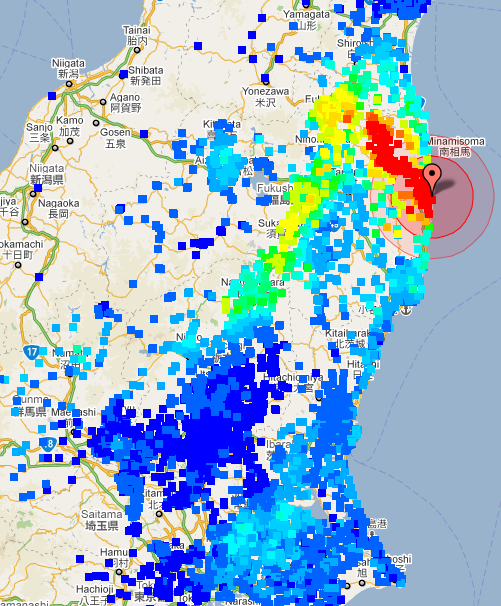
"Radiation limits begin to be exceeded at just above 0.1 microsieverts/ hour blue. Red is about fifty times the civilian radiation limit at 5.0 microsieverts/hour. Because children are much more sensitive than adults, these results are a great concern for parents of young children in potentially affected areas.
"Radiation limits begin to be exceeded at just above 0.1 microsieverts/ hour blue. Red is about fifty times the civilian radiation limit at 5.0 microsieverts/hour. Because children are much more sensitive than adults, these results are a great concern for parents of young children in potentially affected areas.
SOURCE: Science Magazine
The fundamental question is whether the vast array of industrial goods and components "Made in Japan" -- including hi tech components, machinery, electronics, motor vehicles, etc -- and exported Worldwide are contaminated? Were this to be the case, the entire East and Southeast Asian industrial base --which depends heavily on Japanese components and industrial technology-- would be affected. The potential impacts on international trade would be farreaching. In this regard, in January, Russian officials confiscated irradiated Japanese automobiles and autoparts in the port of Vladivostok for sale in the Russian Federation. Needless to say, incidents of this nature in a global competitive environment, could lead to the demise of the Japanese automobile industry which is already in crisis.
While most of the automotive industry is in central Japan, Nissan's engine factory in Iwaki city is 42 km from the Fukushima Daiichi plant. Is the Nissan work force affected? Is the engine plant contaminated? The plant is within about 10 to 20 km of the government's "evacuation zone" from which some 200,000 people were evacuated (see map below).
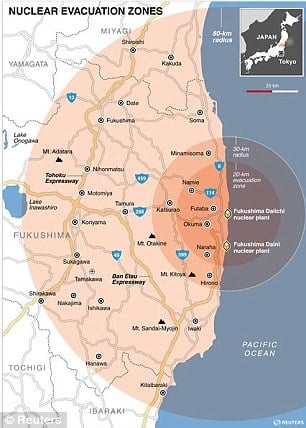
Nuclear Energy and Nuclear War
The crisis in Japan has also brought into the open the unspoken relationship between nuclear energy and nuclear war.
Nuclear energy is not a civilian economic activity.
It is an appendage of the nuclear weapons industry which is controlled
by the so-called defense contractors. The powerful corporate interests
behind nuclear energy and nuclear weapons overlap.
In Japan at the height of the disaster, "the nuclear
industry and government agencies [were] scrambling to prevent the
discovery of atomic-bomb research facilities hidden inside Japan's
civilian nuclear power plants".1 (See Yoichi Shimatsu, Secret Weapons Program Inside Fukushima Nuclear Plant? Global Research, April 12, 2011)
It should be noted that the complacency of both the
media and the governments to the hazards of nuclear radiation pertains
to the nuclear energy industry as well as to to use of nuclear weapons.
In both cases, the devastating health impacts of nuclear radiation are
casually denied. Tactical nuclear weapons with an explosive capacity of
up to six times a Hiroshima bomb are labelled by the Pentagon as "safe
for the surrounding civilian population".
No concern has been expressed at the political level
as to the likely consequences of a US-NATO-Israel attack on Iran, using
"safe for civilians" tactical nuclear weapons against a non-nuclear
state.
Such an action would result in "the unthinkable": a
nuclear holocaust over a large part of the Middle East and Central Asia.
A nuclear nightmare, however, would occur even if nuclear weapons were
not used. The bombing of Iran's nuclear facilities using conventional
weapons would contribute to unleashing another Fukushima type disaster
with extensive radioactive fallout. (For further details See Michel
Chossudovsky, Towards a World War III Scenario, The Dangers of Nuclear War, Global Research, Montreal, 2011)
The Online Interactive I-Book Reader on Fukushima: A Nuclear War without a War
In view of the official cover-up and media
disinformation campaign, the contents of the articles and video reports
in this Online Interactive Reader have not trickled down to to the
broader public. (See Table of contents below)
This Online Interactive Reader on Fukushima contains a
combination of analytical and scientific articles, video reports as
well as shorter news reports and corroborating data.
Part I focusses on The Fukushima Nuclear Disaster: How it Happened? Part II pertains to The Devastating Health and Social Impacts in Japan. Part III centers on the "Hidden Nuclear Catastrophe", namely the cover-up by the Japanese government and the corporate media. Part IV focusses on the issue of Worlwide Nuclear Radiation and Part V reviews the Implications of the Fukushima disaster for the Global Nuclear Energy Industry.
Part I focusses on The Fukushima Nuclear Disaster: How it Happened? Part II pertains to The Devastating Health and Social Impacts in Japan. Part III centers on the "Hidden Nuclear Catastrophe", namely the cover-up by the Japanese government and the corporate media. Part IV focusses on the issue of Worlwide Nuclear Radiation and Part V reviews the Implications of the Fukushima disaster for the Global Nuclear Energy Industry.
In the face of ceaseless media disinformation, this
Global Research Online I-Book on the dangers of global nuclear radiation
is intended to break the media vacuum and raise public awareness, while
also pointing to the complicity of the governments, the media and the
nuclear industry.
We call upon our readers to spread the word.
We invite university, college and high school teachers to make this Interactive Reader on Fukushima available to their students.
Michel Chossudovsky, January 25, 2012
We invite university, college and high school teachers to make this Interactive Reader on Fukushima available to their students.
Michel Chossudovsky, January 25, 2012


